
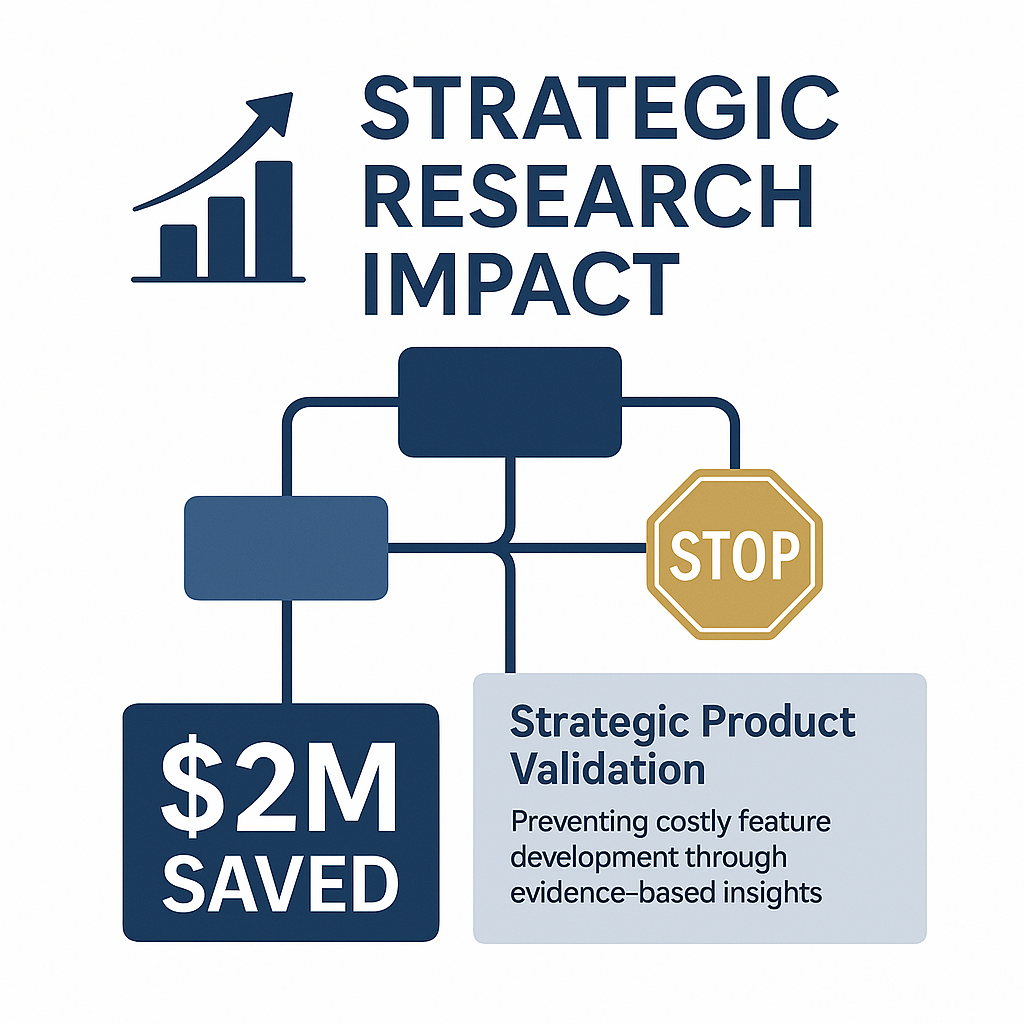
$2M+
Saved
93%
User Abandonment
20%
Revenue Recovery
400:1
ROI
Executive Summary
Universal Challenge: When product teams invest heavily in unvalidated solutions (a pattern affecting 70% of feature launches across industries) research leadership must balance diplomatic redirection with evidence-based truth-telling.
When FBG committed significant engineering resources to a pre-packaged live betting product, I repositioned the validation research to challenge fundamental business assumptions rather than optimize predetermined features. Through strategic research leadership, I identified that the target market was 75% smaller than projected and users had developed learned helplessness around complex live betting. This research prevented $2M+ in development costs while redirecting resources toward proven opportunities that generated 20% increased engagement.
Strategic Business Context
FBG faced intense competitive pressure to capture real-time interaction market share, where complex multi-component products represented the highest-margin opportunity. Leadership had already committed to a pre-packaged live SGP feature, believing it would solve user adoption challenges. However, our complex product engagement remained below 2%.
Strategic Research Question:
Instead of asking “How do we make this feature successful?”, I reframed the research to address fundamental questions:
- Why do users who actively engage in both behaviors consistently avoid combining them?
- What environmental and systemic barriers create learned helplessness in user behavior?
- How can we identify when to pivot versus optimize in product development?
This reframing was critical—it transformed tactical feature validation into strategic product direction.
The Strategic Challenge:
Rather than validating a predetermined solution, I needed to understand why users who actively bet live and build parlays consistently avoid combining these behaviors. This required challenging existing stakeholder commitments while maintaining collaborative relationships and providing alternative strategic directions.
Business Stakes:
Millions in engineering resources, competitive positioning in live betting, and broader product strategy for complex betting products across our platform hung in the balance.
Research Leadership Approach
Strategic Reframing
I repositioned the research from “How do we make live pre-packs successful?” to “Why do users who actively bet live and build parlays avoid combining these behaviors?” This reframing was critical because it allowed us to examine fundamental assumptions rather than optimize a potentially flawed concept.
Methodological Innovation
I designed a multi-method approach that went beyond traditional usability testing:
- Competitive solution evaluation having users demonstrate workflows on competitor platforms.
- Contextual inquiry during live games to observe actual betting behavior in real-time
- Environmental mapping to document physical contexts where betting occurred
- Behavioral data triangulation comparing stated preferences with actual betting history
Traditional usability testing would have validated the feature in isolation, missing critical context. By combining contextual inquiry during live events with behavioral data triangulation and environmental mapping, I uncovered that 50% of usage occurs in environments where complex interactions are impossible—a finding that would never emerge in controlled testing. This mixed-method approach has since become the organizational standard for high-stakes feature validation.
Stakeholder Management Strategy
Recognizing that findings might challenge existing commitments, I pre-aligned on decision criteria, secured agreement that adoption projections below 10% would trigger strategy pivot, built coalition incrementally starting with design partners then expanding to product and engineering, and offered face-saving alternatives by positioning infrastructure improvements as “enablers” rather than replacements.
Key Strategic Insights
Market Cascade Failure Pattern
Market suspensions don’t just delay bets, they create learned helplessness that eliminates future attempts.
Evidence:
93% of participants had completely given up attempting live SGPs, with comments like “I don’t even bother at this point” appearing in 8 of 12 discussions. Users couldn’t identify patterns in suspension behavior, creating unpredictability anxiety.
Business Implication:
The fundamental infrastructure issues needed resolution before any feature-level solutions could succeed. This shifted investment priority from feature development to platform stability.
This pattern appears across industries whenever real-time systems lack reliability, from financial trading platforms to healthcare systems, unpredictability creates user abandonment.
Environmental Reality Constraints
Physical context creates hard constraints on betting complexity that product assumptions ignored.
Evidence:
Only 50% of real-time decision-making occurs in dual-screen environments capable of supporting complex decision-making. Mobile/on-the-go betting limited users to 2-leg maximum complexity, while bar/social viewing prioritized entertainment over optimization.
Business Implication:
Established realistic Total Addressable Market (TAM) for complex live products at 25% of live betting volume, significantly lower than business projections.
This constraint applies broadly across industries, from financial trading to food delivery, wherever users make time-sensitive decisions on mobile devices.
Hidden Success Story
Users successfully build cross-game parlays live but avoid same-game combinations.
Evidence:
63% maintained similar parlay rates live vs. pre-match, but same users with <2% live SGP engagement showed 40-90% cross-game parlay rates. “Cross-game is easy, same game is impossible” emerged as consistent theme.
Business Implication:
Identified immediate optimization opportunity requiring minimal development investment, providing alternative revenue path while infrastructure issues were addressed.
Business Outcomes & Influence
Immediate Strategic Decisions
Deprioritized Live Pre-Packs from Q1 priority to experimental feature, preventing $2M+ investment
Redirected engineering resources to infrastructure improvements and cross-game parlay optimization
I Established new research-first mandate for high-investment features across product organization
Quantified Business Impact
Cost Avoidance: Prevented ~$2M investment in full live pre-pack development
Revenue Generation: 20% increase in live parlay volume from cross-game optimizations within 6 weeks
Strategic Positioning: Research findings became required reading for all product managers, influencing resource allocation across multiple product areas
ROI Achievement: $2M saved from 2-week, $5K research investment = 400:1 return on research investment
Organizational Influence
Research Practice Evolution: I established “confidence degradation model” adopted across betting products
Decision-Making Framework: I created template for cost-benefit analysis including environmental constraints that became standard for major feature decisions
Cultural Change: I shifted organization from feature-first to user-behavior-first approach for major investments
Strategic Reflection
Research Leadership Growth
This project reinforced that Staff-level research leadership means having the courage to deliver unwelcome truths while providing actionable alternatives. The most valuable research doesn’t always validate product directions. Sometimes it prevents costly mistakes.
The Political Capital of Truth: This project taught me that Staff-level research leadership isn’t just about finding insights, it’s about having the political acumen to deliver unwelcome truths while maintaining stakeholder relationships. The ability to say ‘this won’t work’ while simultaneously offering ‘here’s what will’ is what separates senior ICs from true research leaders.
Key Learning: Strategic research leadership requires balancing methodological rigor with business partnership, translating user insights into resource allocation recommendations while preserving stakeholder relationships.
Cross-Industry Applicability
The research framework applies broadly to any organization considering significant investment in complex user behaviors:
- Environmental constraint analysis for feature complexity decisions
- Learned helplessness identification in user adoption challenges
- Infrastructure vs. feature prioritization for complex product ecosystems
- Cascade failure pattern recognition for system-dependent user behaviors
Future Application
This approach, questioning fundamental assumptions rather than optimizing predetermined solutions, has become my standard for high-stakes feature validation, demonstrating how research leadership can drive strategic business decisions while advancing organizational research maturity.
Key Takeaways
For Research Leaders:
- Reframing questions prevents bigger failures than optimizing solutions
- Environmental context often matters more than interface design
- Political capital must be built before challenging major investments
- Offering alternatives preserves relationships while redirecting strategy
- The courage to deliver unwelcome truths defines Staff+ leadership
 James M. Bradley Jr., Ph.D.