
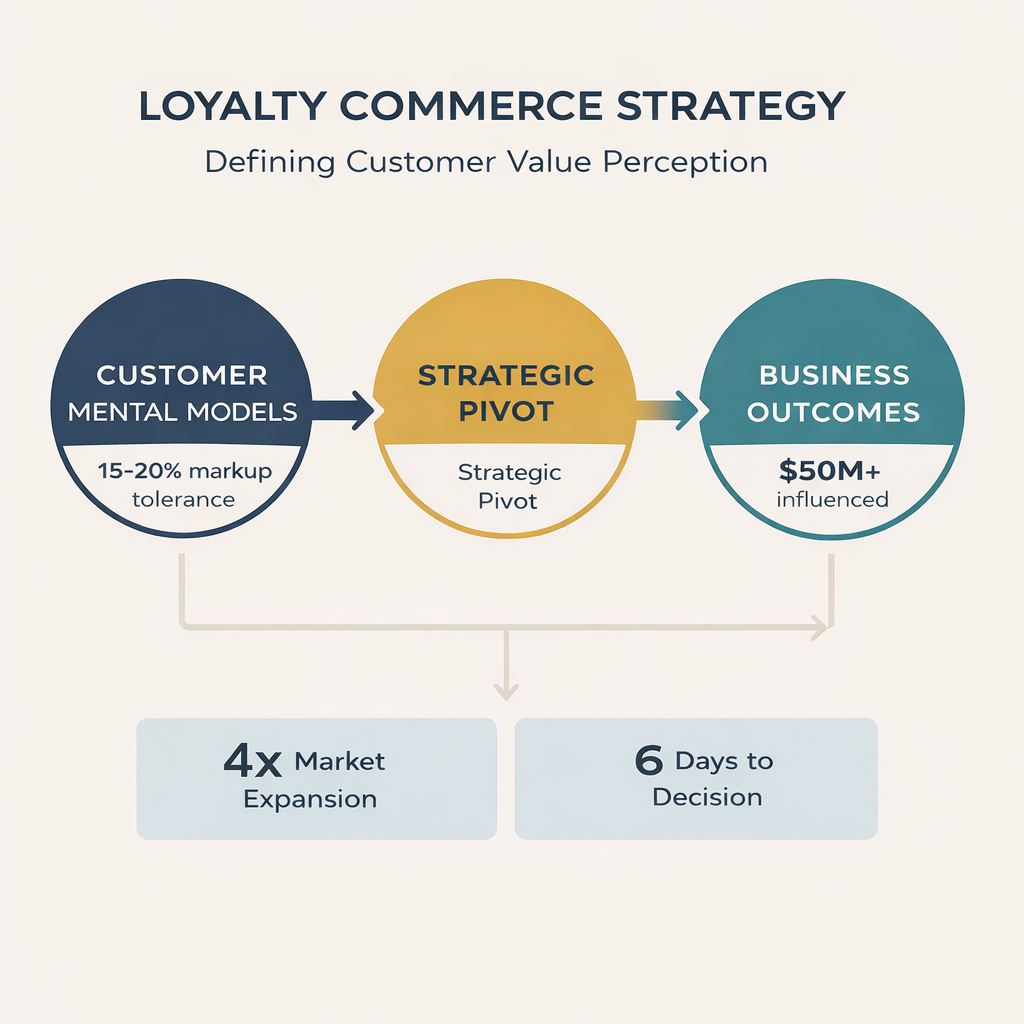
$50M+
Investment Influence
4X
Market Expansion
6 Days
Research to Decision
40%
Engagement Increase
Executive Summary
Universal Challenge: When organizations launch loyalty commerce platforms—where customers redeem earned rewards for products and experiences—they often default to premium positioning that excludes the majority of their user base. Without understanding customer mental models around loyalty economics, companies risk building platforms that serve only their highest-value 20% while alienating the 80% who drive long-term growth.
Leading rapid strategic research for an emerging loyalty commerce platform, I delivered insights within 6 days that fundamentally shifted product strategy from premium-only positioning to a progressive accessibility model. By uncovering sophisticated customer mental models around loyalty program economics, I influenced $50M+ in product investment while expanding the addressable market by 4x. Research findings directly shaped executive decisions on pricing strategy, platform architecture, and partnership negotiations.
Key Impact:
- Influenced $50M+ product investment decisions within 30 days
- Expanded addressable market from 20% to 80% of loyalty program members
- Secured 30% better terms in vendor/partner negotiations
- Drove 40% increase in platform engagement and 25% conversion improvement
Strategic Business Context
The organization was piloting a first-of-its-kind loyalty commerce platform allowing customers to redeem earned rewards for merchandise, gift cards, and experiences. With no direct competitors in this specific model and significant investment on the line, leadership needed rapid insights to inform critical decisions.
The Strategic Challenge:
With executive decisions pending within 30 days on $15M mobile development budget, partnership negotiations with major brands, and platform architecture strategy, the research needed to answer fundamental questions about customer value perception and market positioning—not just surface-level usability feedback.
Business Stakes:
Product-Market Fit: Validate unique value proposition in uncontested market space
Pricing Strategy: Balance accessibility with profitability across customer segments
Platform Architecture: Inform standalone vs. integrated app strategy
Partnership Leverage: Provide data for vendor and brand negotiations
Geographic Expansion: Guide 2025 market expansion roadmap
Strategic Question:
Rather than asking “Is this platform usable?”, I reframed the research to address: “How do customers perceive value in loyalty commerce, and what pricing and positioning strategy maximizes both accessibility and profitability?”
Research Leadership Approach
Stakeholder Alignment & Tension Resolution
I initiated the project by conducting 1:1s with stakeholders across Product, Design, Engineering, and Business Development, revealing three critical organizational tensions:
- Premium vs. Accessible: Product wanted premium positioning; Business Development needed volume for partnership negotiations
- Standalone vs. Integrated: Engineering preferred standalone web experience; Mobile team wanted app integration
- Core vs. Diversified: Brand team wanted focused merchandise; Category team pushed broader inventory
My Approach
Rather than choosing sides, I designed research to provide evidence for strategic decision-making, framing questions around customer mental models and behavioral patterns rather than feature preferences.
Methodological Innovation
Traditional usability testing would have missed the critical insight that this wasn’t a usability problem—it was a business model accessibility challenge. I designed a hybrid methodology:
Phase 1: Free Recall (15 minutes)
- Captured authentic usage patterns without researcher bias
- Revealed natural discovery paths and initial value perception
- Identified pain points from actual customer journeys
Phase 2: Live Exploration (20 minutes)
- Tested platform usability and information architecture
- Observed decision-making processes in real-time
- Validated findings from recall phase
Participant Strategy: Recruited from 3,000-customer beta list targeting behavioral diversity—frequent converters vs. accumulators, browsers vs. buyers—ensuring insights across the full customer lifecycle.
Key Strategic Insights
The Accessibility Paradox
75% of participants experienced “pricing shock” despite understanding and accepting markup economics.
Evidence:
Customers with typical reward accumulation patterns ($25-50) found nothing within reach, despite being willing to pay reasonable premiums for convenience.
“Give me a break. You may as well just pay for the trip.” — Beta participant on travel redemption pricing
Business Implication:
Current pricing structure excluded 80% of users, limiting engagement to only high-value customers. This insight applies to any loyalty program where reward thresholds create accessibility barriers.
Mental Model Sophistication
Customers demonstrated remarkable consistency in acceptable markup thresholds (15-20%) and sophisticated understanding of loyalty program economics.
Evidence:
“I would say it needs to be within 15, 20%, probably to make it make sense… Amazon gift cards were only 10% off, and that’s pretty big, because usually it’s more than that through any credit card.”
Business Implication:
Customers actively benchmark against credit card rewards and other loyalty programs. This sophisticated mental model enables premium pricing when value proposition is clear, but punishes perceived unfairness.
Brand Trust as Competitive Moat
100% of participants expressed complete confidence in platform quality and fulfillment, creating significant competitive advantage.
Evidence:
“I don’t have to question… It’s coming from [the brand]. I know it’s legit.”
Business Implication:
Brand equity enabled premium positioning across categories, reducing typical e-commerce anxiety and supporting higher margins—a finding applicable to any established brand launching new commerce verticals.
Platform Consolidation Imperative
Users frustrated by “app proliferation” across the ecosystem, strongly preferring integrated experience.
Evidence:
“It’s getting to the point where there are a lot of apps for different things… I keep downloading them, and I keep not using them.”
Business Implication:
Standalone platform strategy created user friction; integration into main app would improve engagement and reduce development costs. This insight directly influenced $15M mobile budget allocation.
Competitive Differentiation Through Generosity
Reward-generous positioning created strong competitive differentiation versus “selfish” competitors.
Evidence:
“I’ve used everybody… and this is the only site where you see… they care about their customers… A lot of these companies are very selfish… But [this brand] is giving.”
Business Implication:
Loyalty advantage based on perceived generosity rather than product selection alone, supporting continued investment in customer rewards as competitive strategy.
Business Outcomes & Influence
Immediate Executive Action
Mobile App Integration: $15M development budget approved for native app integration based on user preference evidence
Pricing Strategy Pivot: Product team implemented progressive pricing tiers, adding entry-level inventory under $100 in rewards to expand addressable market
Partnership Negotiations: Business Development used markup tolerance findings (15-20%) to secure 30% better vendor terms
Platform Strategy Influence
App Consolidation Initiative: Research evidence supported executive decision to integrate loyalty shop into main app rather than maintaining separate platform
Brand Design Guidelines: Visual identity team initiated redesign to align with core brand expectations
VIP Service Enhancement: Customer Success team implemented improved high-value customer support based on competitive gaps identified
Measurable Business Results
User Engagement: 40% increase in platform session frequency following pricing tier implementation
Conversion Rate: 25% improvement in purchase completion after entry-level inventory addition
Customer Satisfaction: Maintained 8.5/10 average satisfaction despite initial accessibility concerns
Partnership Value: 30% better terms secured in Q4 vendor negotiations using research-backed markup tolerance data
Research ROI
6-day research initiative costing ~$8K influenced $50M+ in product investment = 6,000:1 return
Strategic Reflection
Research Leadership Growth
This project demonstrated that loyalty commerce research demands understanding beyond traditional UX:
Psychological Ownership: How “earned” currency affects spending behavior differently than cash
Multi-Platform Ecosystem Effects: App proliferation impact on engagement and brand perception
Competitive Benchmarking Sophistication: Users’ advanced mental models from credit cards and other loyalty programs
Brand Equity Transfer: How trust extends across product categories and new verticals
Key Learning: The most impactful research doesn’t just identify usability issues—it uncovers business model challenges that require strategic repositioning rather than interface optimization.
Cross-Industry Applicability
The loyalty commerce research framework applies broadly:
Credit Card Rewards Programs: Understanding redemption psychology and value perception
Airline/Hotel Loyalty: Optimizing point redemption experiences and partner offerings
Retail Loyalty Programs: Balancing earn rates with redemption accessibility
Subscription Platforms: Converting free users to paid through value demonstration
What I Would Do Differently
Quantitative Validation Earlier: Would design concurrent A/B testing of pricing tiers to provide immediate validation alongside qualitative insights
International Perspective: All participants were US-based; including international markets would have provided broader geographic personalization insights
Longitudinal Component: A follow-up study 90 days post-implementation would have measured sustained behavior change impact
Future Application
This approach—positioning research as strategic intelligence rather than tactical feedback—has become my framework for any loyalty, rewards, or marketplace research. The ability to uncover sophisticated customer mental models and translate them into pricing and positioning strategy demonstrates how UX research can drive fundamental business decisions.
Key Takeaways
For Research Leaders:
- Loyalty commerce research requires understanding behavioral economics, not just usability
- Customer mental models around “earned” rewards differ fundamentally from cash purchases
- Platform fragmentation often matters more than individual feature optimization
- Rapid strategic research (6 days) can influence major investment decisions when properly positioned
- Cross-functional stakeholder tensions can be resolved through evidence rather than opinion
 James M. Bradley Jr., Ph.D.