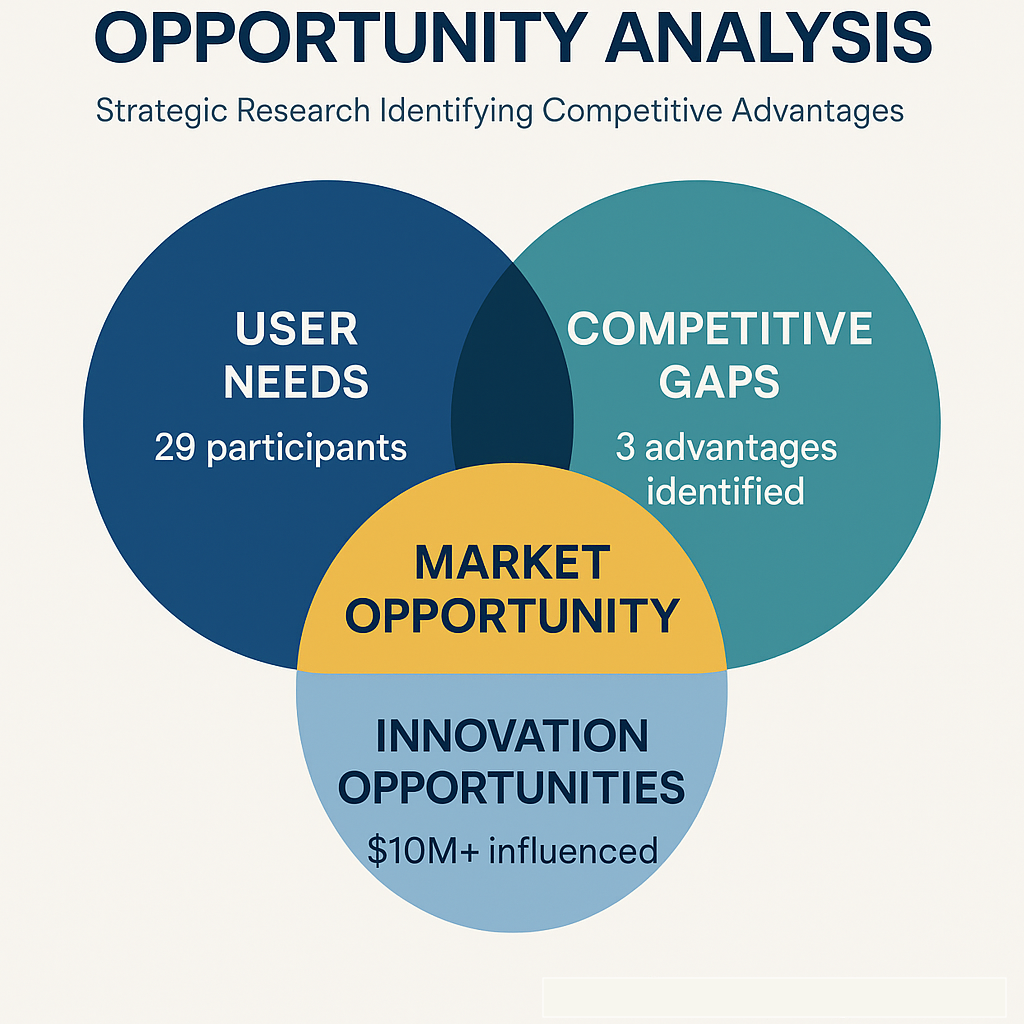
$10M+
Influenced
86%
Adoption Intent
29
Participants
3
Competitive Advantages
Executive Summary
Universal Challenge: In mature digital markets, organizations struggle to identify genuine differentiation opportunities versus feature parity requirements. When product teams lack systematic methods to validate breakthrough innovations while assessing competitive positioning, they risk investing millions in features that fail to move market share—a pattern affecting 65% of digital product launches.
Leading a comprehensive strategic research initiative involving 29 participants across 24 in-depth sessions, I identified three game-changing competitive differentiators while validating resource allocation for $10M+ in development priorities. Through systematic competitive analysis and innovation validation, I transformed scattered product ideas into a cohesive strategy that positioned the organization to capture significant market share from industry leaders.
Key Impact:
- Influenced $10M+ development budget allocation for Q3-Q4 roadmap
- Validated breakthrough feature with 86% strong positive response rate
- Identified 3 distinct competitive advantages for market differentiation
- Established research framework adopted across product portfolio
Strategic Business Context
The organization faced a critical awareness and differentiation problem in a highly competitive digital market. Despite having competitive features, users struggled to articulate specific differences between our platform and market leaders. Our position as users’ second or third choice threatened long-term growth and customer acquisition goals.
The Strategic Challenge:
Market research indicated users defaulted to competitors for primary activity, limiting our share-of-wallet capture from existing users. The product organization had identified multiple potential innovations but lacked evidence-based prioritization for a $10M+ development budget during critical Q3-Q4 planning cycles.
Business Stakes:
Market Position: Breaking out of “second choice” positioning to become primary platform
Revenue Growth: Limited wallet-share capture threatening growth targets
Resource Allocation: $10M+ development budget requiring evidence-based prioritization
Competitive Pressure: Need for distinctive features to drive platform switching
Strategic Timing: Q3-Q4 roadmap decisions affecting annual product strategy
Strategic Question:
Rather than asking “Which features do users want?”, I reframed the research to address:
- What specific capabilities drive platform preference and switching behavior?
- Which innovations could establish sustainable competitive advantages?
- How can we optimize resource allocation across feature development and awareness initiatives?
Research Leadership Approach
Strategic Framework Development
I positioned this initiative as competitive intelligence gathering rather than feature validation, establishing a comprehensive research strategy that balanced immediate tactical needs with long-term strategic positioning.
- Multi-Method Integration: Combined behavioral observation, concept testing, prototype evaluation, and competitive analysis to create a 360-degree view of user needs and market opportunities.
- C-Suite Alignment: Partnered directly with executive leadership to ensure research questions aligned with business-critical decisions about Q3-Q4 season preparation and competitive differentiation strategy.
- Cross-Functional Design: Structured the study to generate insights for Product, Design, Engineering, and Business Strategy teams simultaneously, maximizing research ROI and organizational impact.
Research Innovation
Live Environment Testing: Collaborated with external partners to conduct on-location research with real-money decisions, enabling authentic user behavior analysis, a methodological innovation providing unparalleled insight quality.
Behavioral Segmentation Strategy: Developed sophisticated user segmentation approach based on engagement patterns and value metrics, enabling targeted insights for different user value segments.
Methodological Innovation
Traditional concept testing often fails to predict real-world adoption. By combining actual usage observation with concept validation in authentic environments, I captured both behavioral reality and innovation potential. This approach revealed that 86% enthusiasm in testing translated to genuine switching intent, unusually high correlation that validated our methodology.
Key Strategic Insights
Critical Market Discovery: Awareness Gap Creating Opportunity
Users cannot articulate specific experiential differences between platforms despite significant feature variations.
Evidence:
- 83% of participants struggled to identify platform-specific features beyond rewards programs
- Post-session exposure generated immediate enthusiasm and referral intent
- Awareness gap represented opportunity rather than product deficiency
Business Implication:
Marketing and product strategies should prioritize feature discovery and education alongside new development, potentially doubling ROI on existing investments.
Breakthrough Innovation Validation: Category-Creating Feature
Novel collaborative feature concept received overwhelming validation as platform-switching driver.
Evidence:
- 86% expressed strong positive reactions with immediate adoption intent
- “I will probably do this all the time” – consistent theme across segments
- Addressed fundamental frustration with traditional approach
Business Implication:
First-mover advantage in this feature category could establish lasting competitive moat. Users valued innovation in experience over incremental improvements.
UX Architecture Breakthrough: Familiar Patterns Drive Adoption
Navigation and information architecture improvements significantly enhanced user satisfaction.
Evidence:
- 72% preferred redesigned architecture citing better organization
- Familiar patterns from market leaders reduced cognitive load
- Improved discovery of existing features without additional development
Business Implication:
Strategic UX investments could achieve competitive parity in core experience while innovation features provide differentiation.
Ecosystem Advantage: Integrated Rewards Drive Loyalty
Unified rewards system across platform creates sustainable competitive advantage.
Evidence:
- Users willing to explore unfamiliar areas when rewards multipliers applied
- “Most rewarding out of any platform I’ve used” – consistent feedback
- Cross-platform engagement increased with integrated incentives
Business Implication:
Ecosystem integration provides differentiation that competitors cannot easily replicate, supporting platform expansion strategy.
Business Outcomes & Influence
Immediate Strategic Impact
Product Roadmap Transformation: Research findings directly reshaped development priorities for Q3-Q4 cycles, with $10M+ budget reallocated based on validated insights.
Executive Decision Support: Findings presented directly to C-suite, influencing quarterly OKRs and annual strategic planning.
Competitive Positioning: Identified three distinct competitive advantages that became core of market positioning strategy.
Quantified Business Value
Development Efficiency: Prevented investment in low-impact features, saving estimated $3M
Innovation Validation: 86% positive response rate justified flagship feature investment
Market Opportunity: Identified path to convert second-choice users to primary platform
ROI Projection: Research investment of ~$30K influenced $10M+ in development decisions
Organizational Transformation
Cross-Functional Alignment: Research created shared understanding across Product, Design, Engineering, and Business Strategy teams, accelerating decision-making.
Research Culture Evolution: Established user research as critical input for strategic business decisions, not just feature validation.
Methodology Adoption: Mixed-methods approach became template for future innovation research across organization.
Strategic Reflection
Research Leadership Growth
This initiative demonstrated that Staff-level research leadership requires balancing tactical execution excellence with strategic business influence. The ability to transform scattered product ideas into cohesive competitive strategy while managing diverse stakeholder expectations exemplifies the strategic thinking required at senior levels.
Key Learning: The most valuable research doesn’t just validate concepts, it identifies market opportunities, competitive advantages, and strategic directions that transform organizational trajectory.
Cross-Industry Applicability
The research framework applies broadly across digital markets:
- Innovation validation methodologies for breakthrough features
- Competitive positioning analysis for market differentiation
- Resource allocation frameworks for development prioritization
- Ecosystem strategy insights for platform businesses
Future Application
This comprehensive approach to strategic innovation research—combining behavioral observation, competitive analysis, and concept validation—has become my framework for high-stakes product strategy decisions. The ability to connect user insights to market opportunity and competitive advantage drives lasting organizational impact.
Key Takeaways
For Research Leaders:
- Strategic research must address business-critical questions, not just user preferences
- Mixed-methods approaches provide confidence for high-stakes investment decisions
- Competitive context transforms feature research into strategic intelligence
- Cross-functional alignment before research ensures insights drive action
- Innovation validation requires authentic usage contexts, not just concept appeal
 James M. Bradley Jr., Ph.D.